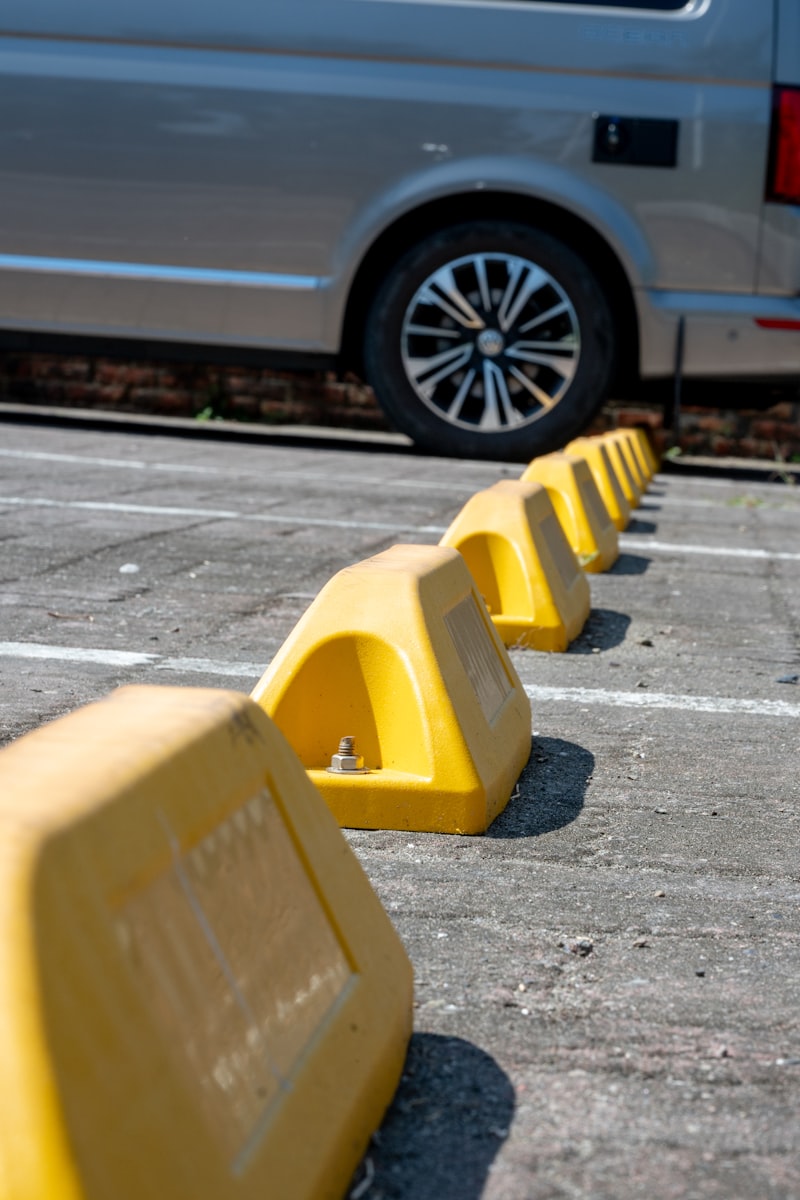
Most people know exactly what they are but not what they are called. The bumpers at the end of a parking stall that stop your front tires from rolling too far into the landscaping, sidewalk, or the vehicle parked on the other side. If you have ever googled “what are those concrete things in parking lots,” you are not alone. It is one of the most searched questions in the parking lot industry.
The answer: they are called wheel stops. You may also hear them called parking blocks, curb stops, bumper blocks, tire stops, or car stops. All of these terms refer to the same thing. “Wheel stop” is the most technically accurate term used by OSHA, the National Pavement Contractors Association, and most commercial contractors. “Parking block” and “parking bumper” are the names most property managers and tenants use in conversation.
What Wheel Stops Actually Do
The primary job of a wheel stop is to mark the end of a parking stall and prevent vehicles from overhanging onto sidewalks, curbs, landscaping, or adjacent spaces. A standard parking stall is 18 feet deep. Most vehicles are 14 to 16 feet long. Without a wheel stop defining the endpoint, vehicles park inconsistently. Some pull too far forward and overhang the walkway; others leave too much space at the rear and waste stall capacity.
Secondary functions include:
Pedestrian safety. When someone is walking in front of a parked car, a wheel stop gives drivers a clear tactile signal to stop. Without one, slow rolling into a crosswalk or walkway happens more than most property managers realize.
Curb and landscaping protection. Without wheel stops, vehicle bumpers repeatedly impact raised curbs, curb cuts, light pole bases, and landscaping edges. That wear adds up quickly.
Liability reduction. A parking lot without wheel stops, or with stops that are broken or improperly marked, creates documented liability exposure. Insurance underwriters look at parking lot maintenance when pricing commercial property coverage.
What Wheel Stops Are Made Of
Concrete
Concrete is the most common material for commercial parking lots. A standard concrete wheel stop is 6 feet long, 6 inches tall, and 8 inches wide. It weighs around 275 pounds and is anchored with two rebar spikes or lag bolts into the asphalt.
In the Salt Lake Valley, there is one important consideration with concrete stops: freeze-thaw cycling. When water infiltrates the small gaps between the stop and the asphalt surface, expands as it freezes, and then contracts as it thaws, concrete stops can shift, crack, or gradually work themselves loose. The Utah Asphalt Pavement Association attributes this pattern to the Wasatch Front averaging 50 to 70 freeze-thaw cycles per winter. By spring, stops that were flush to the surface in October can have a raised edge that becomes a trip hazard.
Annual inspection and re-anchoring of concrete stops is good practice for any commercial lot on the Wasatch Front.
Recycled Rubber
Rubber wheel stops are made from recycled tires and are significantly lighter than concrete, typically 35 to 60 pounds for a standard 6-foot stop. They are anchored with lag bolts and have more flex than concrete, which means they absorb impacts better and are less likely to spall or crack in freeze-thaw conditions.
For Salt Lake Valley lots, rubber wheel stops have a practical advantage beyond freeze-thaw resilience: snow removal. Plow operators catch raised or shifted concrete stops with the blade, which either dislodges the stop entirely or damages the plow. Rubber stops flex rather than catch, and they are low enough that most commercial plow blades clear them without issue. If your lot sees active snow removal, rubber stops are worth the cost premium.
Recycled Plastic
Plastic wheel stops are the most corrosion-resistant option and are often used in parking structures or covered areas where drainage is poor. They do not absorb water, do not spall, and do not conduct the freeze-thaw cycle the way concrete does. The tradeoff is cost. Recycled plastic stops typically run higher than concrete on a per-unit basis, and they are lighter, which means anchoring quality matters more.
Standard Dimensions and Placement
A standard commercial wheel stop is 6 feet long. The recommended setback from the front face of the stall is generally calculated so the stop contacts the tire at the correct point, not the bumper. A wheel stop placed too close to the stall line catches bumpers before the tire; too far back and it does not serve its purpose.
The typical placement is approximately 2 to 3 feet from the front edge of the stall, measured from the face of the wheel stop to the front stall line. Your contractor should measure based on your specific lot layout and vehicle mix rather than using a fixed number.
ADA Considerations
Wheel stops affect ADA compliance in ways that many property managers do not anticipate. The ADA Standards for Accessible Design prohibit wheel stops from reducing the clear width of an accessible aisle or encroaching on an accessible route.
Specifically:
- Wheel stops cannot be placed in a way that reduces the accessible aisle width below 60 inches for standard accessible stalls or 96 inches for van-accessible stalls.
- They cannot be placed on an accessible pedestrian path or at locations where they become trip hazards for people with mobility impairments.
- If a wheel stop shifts during winter and encroaches on an accessible aisle, the lot is technically out of ADA compliance until the stop is repositioned.
For commercial properties in the Salt Lake Valley, ADA stall maintenance including wheel stop positioning should be part of the annual spring inspection after the freeze-thaw season ends.
Painting and Marking Wheel Stops
New concrete wheel stops are typically unpainted gray. Painted stops are more visible, especially in low-light conditions, and are required in many commercial lease agreements. The standard colors are:
Yellow: Most common for general parking stalls. High visibility against gray asphalt.
Blue: Used to mark accessible parking stalls. ADA guidelines do not technically require a specific stop color, but blue stops at accessible stalls have become the industry norm in the Salt Lake Valley.
Red: Fire lane wheel stops and no-parking zones where stops are installed.
Wheel stop paint wears faster than stall line paint because it receives direct tire contact. Budget for repainting every 12 to 18 months on actively used stops, or at the same time as your regular parking lot restripe.
When to Replace Wheel Stops
Signs that a wheel stop needs replacement rather than just repainting:
- Cracks that penetrate more than surface depth: concrete stops that have fractured through the body will not hold their anchor position through another winter
- Loose or rocking stops: a stop that moves underfoot has lost its anchoring; a loose stop is a trip hazard
- Settled below lot grade: a stop that has sunk below the asphalt surface is no longer functional
- Spalling concrete: significant surface flaking exposes rebar and creates a sharper surface than intended
Replacement is typically done in conjunction with a parking lot restripe so the crew is already working the surface.
What Installation Involves
Professional wheel stop installation on a commercial lot follows this sequence:
- Layout marking: position is chalked before any drilling
- Core drilling or spike driving: two anchor points per stop, either with a core drill into the asphalt and epoxy-set rebar, or with lag bolts through pre-drilled holes
- Placement and seating: the stop is leveled and seated flush to the asphalt surface
- Painting: yellow, blue, or red depending on stall type
- Final position confirmation: stall lines should be repainted after stops are in final position to ensure alignment
Stops installed without proper anchoring in Salt Lake Valley asphalt will not stay in position through winter. Concrete thermal contraction and asphalt movement in freeze-thaw cycles pull stops loose within one or two seasons if the anchoring is inadequate.
If you are planning a parking lot restripe or noticing wheel stops that have shifted, cracked, or worn down over the winter, get a free on-site assessment. We evaluate stop condition as part of every lot inspection across our 8 Salt Lake Valley service areas.