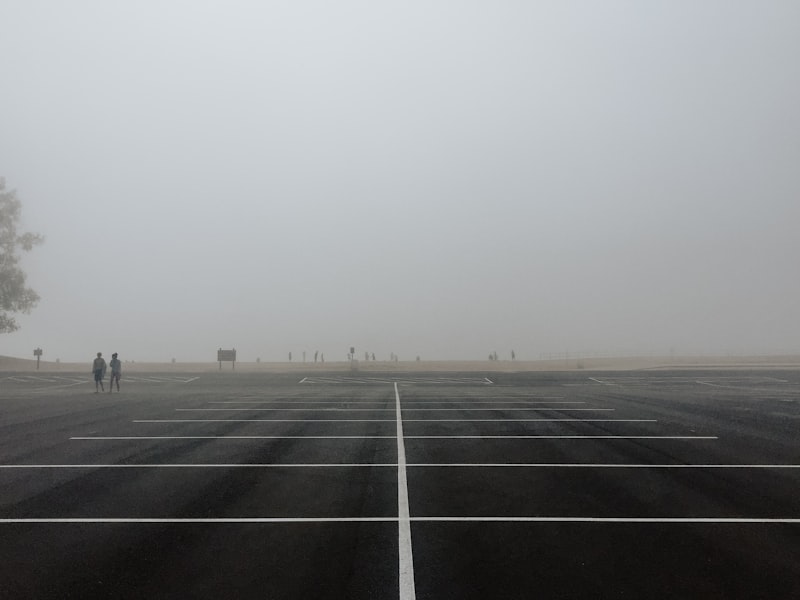
Walk through any parking lot in the Salt Lake Valley and you are looking at one of three materials: water-based traffic paint, thermoplastic, or in older covered structures, epoxy or MMA. The choice between them is not just about cost. It is about how long you need the markings to last, what kind of traffic the lot sees, and how altitude UV and freeze-thaw cycling affect each material’s service life in this climate specifically.
Here is a plain-language breakdown of every material type, what it is, and when to use it.
Water-Based Traffic Paint
This is the most common parking lot striping material in the country and the default choice for most commercial restripes in the Salt Lake Valley.
What it is: A water-based acrylic or latex paint formulated for traffic use. It is applied by spray machine at 4-inch line width for stall lines, 6-inch for stop bars, and 12-inch for crosswalk stripes. Glass beads are sometimes broadcast into the wet paint immediately after application to create retroreflectivity (the way stripes catch headlights at night).
Drying time: 30 to 60 minutes for foot traffic; 4 to 6 hours before vehicles return in normal conditions.
Durability in Salt Lake City: This is where the national guidance stops being useful. Water-based paint on a sealed lot at sea level typically holds 2 to 3 years before restriping is needed. At Salt Lake City’s altitude (4,200 feet on the valley floor, higher in Draper and Cottonwood Heights), UV intensity is meaningfully stronger than at sea level. Asphalt surfaces in direct summer sun exceed 130 degrees Fahrenheit. Both factors accelerate paint breakdown.
In practice, high-traffic commercial lots in the Salt Lake Valley on Bangerter Highway, State Street, and the I-15 retail corridors need water-based restriping every 12 to 18 months. Lower-traffic lots with good sun exposure can stretch to 24 months. A lot with overhead coverage can go longer.
Best for: Standard commercial restripes on sealed surfaces, budget-constrained projects, lower-traffic suburban retail and office lots, any lot where the goal is a complete restripe at a scheduled maintenance interval.
Not ideal for: Entry lanes, drive-through lanes, high-traffic crosswalks, or any area that takes concentrated vehicle loads. These spots wear through water-based paint within a single season and are better served by thermoplastic.
Thermoplastic
Thermoplastic is the professional contractor’s choice for high-traffic areas and any application where longevity per dollar matters more than upfront cost.
What it is: A solid material (pre-formed pellets or blocks) heated to approximately 400 degrees Fahrenheit in a kettle machine, then applied to the pavement surface as a liquid. As it cools, it hardens into a thick, durable coating that is 100 mils (approximately 2.5 mm) thick, about 10 times thicker than a coat of traffic paint. Glass beads are embedded in the surface during application for retroreflectivity, meeting National Pavement Contractors Association standards for commercial marking durability.
Drying time: Return to traffic in 15 to 30 minutes as the material cools. Full hardness is essentially immediate with no extended cure period.
Durability in Salt Lake City: This is where thermoplastic’s case gets compelling at SLC’s altitude. At sea level, thermoplastic typically lasts 3 to 7 years on a well-sealed asphalt surface. At 4,200 feet with stronger UV exposure, thermoplastic lasts 3 to 5 years, still well ahead of water-based paint’s 12 to 18 month interval on comparable traffic.
For high-traffic entry lanes and crosswalks, the math usually favors thermoplastic even though the per-linear-foot cost is three to five times higher than water-based paint. If you are repainting water-based every 12 months, three to four repaints over five years costs more than one thermoplastic application that lasts the same period.
Best for: Entry lanes, drive-through lanes, stop bars, crosswalks, fire lane markings, any area with concentrated or channeled vehicle traffic. Also the correct choice for any marking that needs to be visible after a Utah winter. Thermoplastic holds its retroreflectivity through snow, ice, and plowing better than water-based paint.
Not ideal for: Concrete surfaces (thermoplastic does not adhere well to concrete without primer; epoxy or MMA are the right materials there). Very small-scale jobs where mobilizing the kettle equipment is not cost-effective.
Oil-Based Paint
Oil-based traffic paint was the industry standard before water-based formulations became viable. It is still available and still used in some markets, but it is the least common choice for new commercial work in Utah today.
What it is: Alkyd-based traffic paint applied the same way as water-based but with much longer dry times. Vehicle traffic typically requires 6 to 8 hours, and full cure takes 48 to 72 hours.
Durability: Somewhat better than water-based in high-humidity markets. In Salt Lake City’s dry climate, the durability advantage over water-based is minimal.
Regulatory note: Some states and municipalities restrict oil-based traffic paint due to VOC content. Utah does not currently ban it, but water-based produces a cleaner application in terms of fumes and is the default recommendation for lots in active use.
Best for: There are very few situations today where oil-based is the right first choice for a new commercial project. It is sometimes used on concrete surfaces where thermoplastic or epoxy is not appropriate and water-based adhesion is poor, but even that application has better alternatives.
Epoxy and MMA (for covered structures)
These materials are for parking structures, covered garages, and interior floors, not outdoor asphalt lots.
Epoxy: Two-component material mixed at application. Very high adhesion to concrete, excellent chemical resistance, moderate dry time (4 to 8 hours depending on formulation and temperature). The right choice for enclosed parking structures where the floor sees chemicals (oil, de-icing fluids) and needs a hard, cleanable surface.
MMA (methyl methacrylate): Fast-curing two-component material. Return to traffic can be as fast as 30 to 60 minutes. Used in parking garages that need minimal downtime. Higher cost than epoxy but the fast cure often justifies the premium in high-occupancy structures.
Neither epoxy nor MMA is appropriate for outdoor asphalt. They are designed for concrete surfaces.
Matching Material to Surface Type
| Surface | Recommended Material |
|---|---|
| Outdoor asphalt (standard commercial) | Water-based traffic paint |
| Outdoor asphalt (high-traffic zones) | Thermoplastic |
| Outdoor asphalt (fire lanes, crosswalks) | Thermoplastic |
| Indoor concrete (parking structure) | Epoxy or MMA |
| Indoor concrete (warehouse floor) | Epoxy or water-based traffic paint |
| Concrete outdoor surface | Water-based with concrete primer, or MMA |
The Salt Lake City Altitude Factor
One variable that matters more here than in most markets: altitude UV.
UV intensity increases roughly 4 percent per 1,000 feet of elevation. The Salt Lake Valley floor at 4,200 feet sees 17 to 18 percent more UV than sea level, a factor the Utah Asphalt Pavement Association cites as a primary driver of accelerated pavement wear across the Wasatch Front. The east bench suburbs like Draper, Cottonwood Heights, and Holladay at 4,800 to 5,200 feet see even more.
This means every paint type has a shorter effective service life here than national manufacturer specs suggest. Manufacturer durability claims are typically tested in climate-controlled or moderate-UV conditions. Apply a 20 percent reduction to any published lifespan figure when planning for a Salt Lake Valley lot.
The practical implication: if you are choosing between water-based and thermoplastic for a high-visibility lot on State Street or Bangerter Highway, and the cost difference is the main hesitation, run the math on restripe frequency rather than per-linear-foot cost. The altitude makes thermoplastic’s per-year cost advantage larger here than the product sheets suggest.
What We Recommend for Salt Lake Valley Commercial Lots
For a standard commercial lot with mixed-use traffic and a regular maintenance schedule:
- Standard stall lines: water-based traffic paint with glass beads for retroreflectivity
- Entry lanes, crosswalks, stop bars: thermoplastic
- Fire lane markings and curb painting: thermoplastic or water-based depending on curb material and desired longevity
- ADA accessible stall markings: thermoplastic for the ISA symbol and access aisle legend. These get direct foot and tire contact and need to last.
We give you a line-item quote broken out by material after the on-site assessment, so you can see exactly what each material choice adds and decide where the upgrade makes sense for your specific lot.
Get a free on-site estimate for your Salt Lake Valley parking lot restripe. We cover 8 suburbs across the valley and carry both water-based and thermoplastic materials on every crew.